
A plain-English guide to October's HTTP2Shell vulnerability
In October, one of the most widespread security bugs I've seen in a while made the rounds. Depending on where you read about it, it was called Node2Shell, HTTP2Shell or, my personal favourite, Broccoli2Shell. Officially it's CVE-2026-111497. Three names, one bug, and it lived in a piece of software most people had never heard of.
I sat down with Bee to talk it through on video, and a few people have asked for the written version. So here it is, minus the jargon.
What is Brotli?
Brotli is a compression library made by Google. Compression just means making data smaller so it travels faster over the internet, then unpacking it on the other side.
Bee's analogy was better than mine, so I'll borrow it. You know those vacuum storage bags you put clothes in, then suck the air out so they fit in your suitcase? That's compression. Squash it down, send it, unpack it when it arrives.
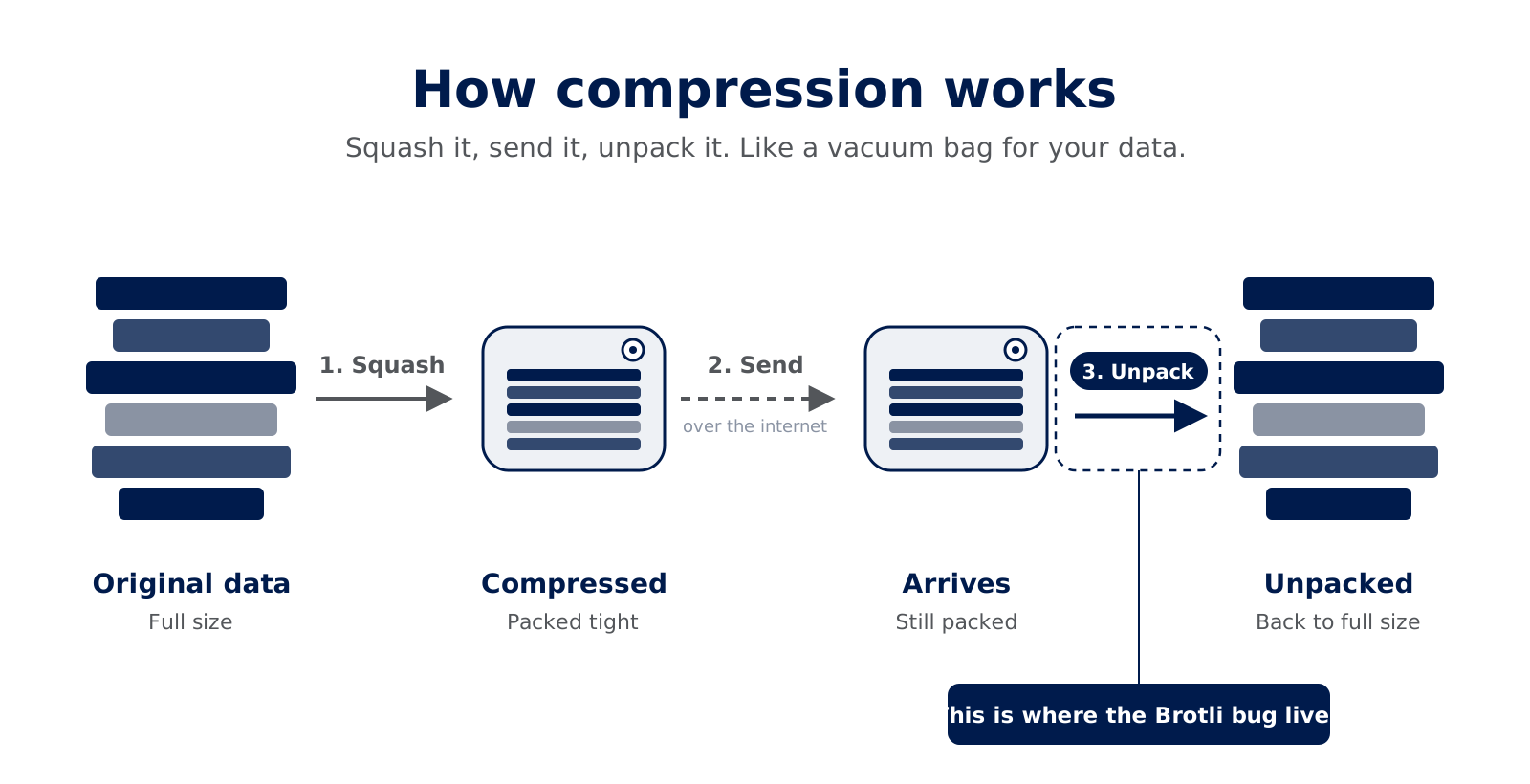
Because smaller data means faster websites, Brotli ended up built into a huge amount of software. Node.js, .NET, Python packages, proxies, web servers. Most of the time nobody chose it directly. It just came along with something else.
What went wrong?
The bug was in the unpacking. When Brotli decompresses data, it's supposed to work inside a set amount of memory. With the right kind of specially crafted data, an attacker could push it to write outside that space, into memory it was never meant to touch.
Depending on the setup, that could:
- - Crash the application
- - Leak information sitting in memory
- - In some cases, let an attacker run their own code on the server
That last one is where the "Shell" in all three names comes from. Getting a shell means getting the ability to run commands on someone else's machine.
Why it got so much attention
The part that bothered me most, and that bothers me about plenty of bugs like this, is that nobody had to do anything wrong. No dodgy link, no weak password, no click.
In some configurations, incoming data gets decompressed before the system even asks who you are. So the attack happens before login is even part of the picture.
It also wasn't just a theory. By late October, the US Cybersecurity and Infrastructure Security Agency (CISA) had added it to its list of vulnerabilities known to be exploited in the wild.
And the names?
Node2Shell came first, from the Imperva research team that showed it working against Node.js. Once researchers saw the same flaw reached Python, curl and plenty of other HTTP tools, it got renamed HTTP2Shell to reflect how far it spread. Broccoli2Shell started as a joke because Brotli sounds a bit like broccoli, and it stuck.
One thing worth clearing up: despite the name, HTTP2Shell had nothing to do with HTTP/2. It was all Brotli.
What to do about it
If you haven't checked yet, it's not too late. Update anything that uses Brotli to a fixed version. For Brotli itself, that's 1.2.1, 1.1.1 or 1.0.10 depending on which branch you're on. Node.js and Microsoft .NET both released their own fixes in October.
The bigger lesson is knowing where libraries like Brotli live in your environment in the first place. I've written more about that in a separate post.
Not sure where you stand?
Knowing you might be vulnerable is one thing. Knowing whether someone can actually get in is another, and that's exactly what a vulnerability assessment tells you.
If you'd rather not work it out alone, we can help. Through A Team Protection, we run external and internal vulnerability assessments, penetration testing and Office 365 security assessments, so you get a clear picture of where you're exposed and what to fix first.