
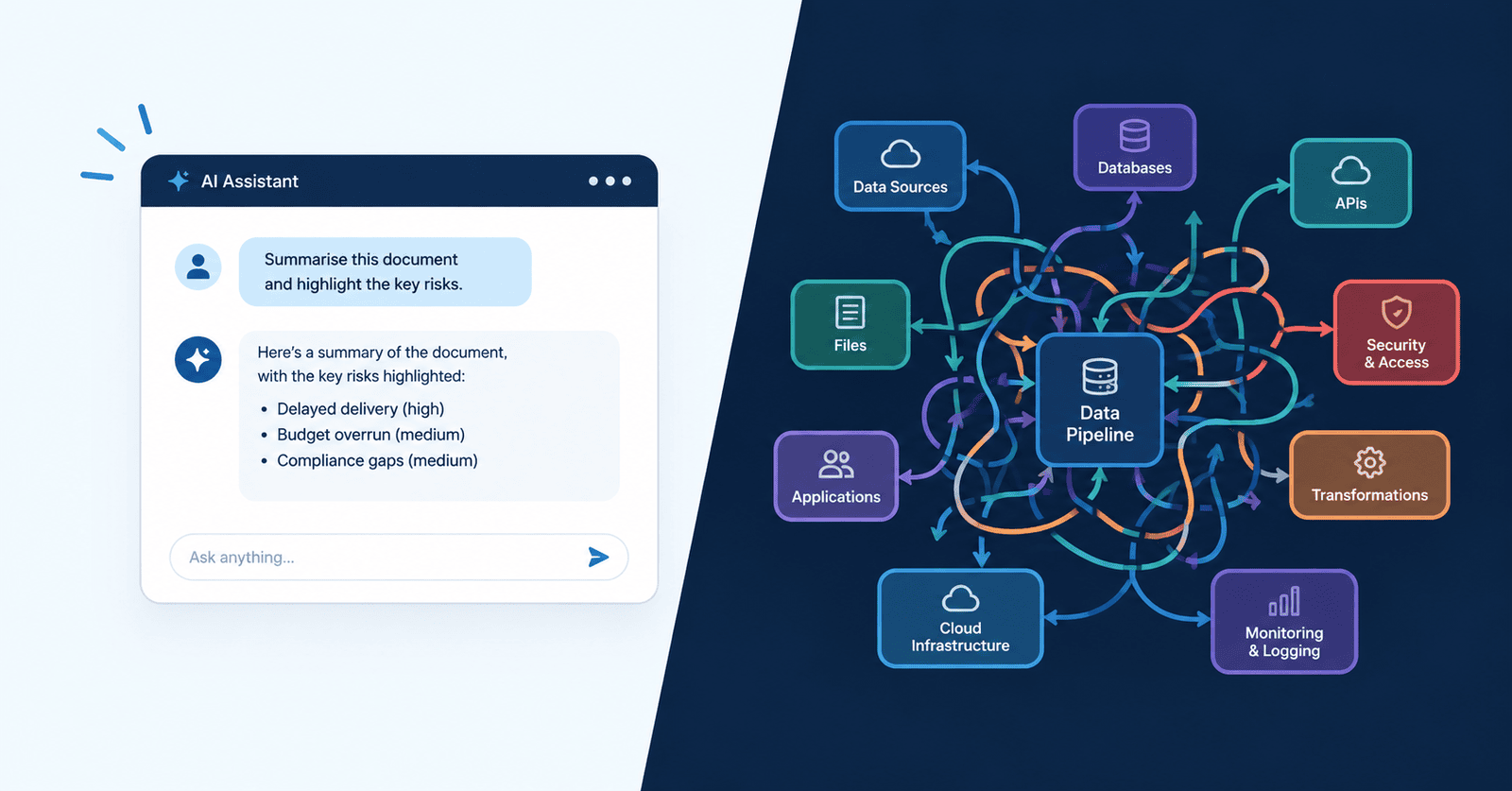
We've all watched an impressive AI demo. Clean data, a scripted question, a perfect answer. What almost nobody talks about is what happens next, when that same idea has to run on your own data, inside your own systems, without a script.
That gap, between the demo and an AI pilot that actually works day to day, is where most AI initiatives quietly die. Not because the technology fails. Because almost nobody plans for the part that comes after the demo.
Why most AI pilots fail: the numbers
Independent research through 2026 keeps landing in the same place. MIT's NANDA initiative reviewed hundreds of enterprise generative AI deployments and found that the overwhelming majority delivered no measurable financial return, not a small return, none. RAND's analysis puts the overall AI project failure rate above 80%, roughly double the failure rate of a conventional IT project. Multiple independent studies through the year converge on an AI pilot-to-production failure rate sitting between 86% and 95%, depending on how strictly "production" gets defined.
The detail that matters most in all of that research: the model is almost never the reason. The demos work. The reviews are positive. Then the pilot meets the actual environment, real data, real authentication, real workflow dependencies, and quietly stalls.
Why this shows up so often in Copilot Studio specifically
This pattern is especially visible in Microsoft Copilot Studio, and that's not a coincidence. Copilot Studio is genuinely good at getting a working demo up fast, low-code, drag-and-drop, connected to a sample data source in an afternoon. That's a real strength. It's also exactly why the demo-to-production gap catches so many Microsoft 365 organisations off guard: the barrier to an impressive first version is so low that it's easy to mistake "the agent works in the demo" for "the agent is ready."
What Copilot Studio's interface doesn't show you is everything sitting just underneath: which knowledge sources the agent should actually be allowed to draw from, whether general model knowledge needs to be switched off to stop it hallucinating, how it authenticates against your real CRM or SharePoint data instead of a sample connection, and who owns it once it's live in Teams and someone's actually relying on it. None of that is a Copilot Studio limitation. It's the same demo-to-production gap this whole piece is about, just wearing a Microsoft 365 badge.
Microsoft's own product design draws this exact line, which is a useful confirmation that the distinction is real rather than something vendors gloss over. Copilot Studio's self-service trial lets you build and test an agent internally, but agents on that tier can't be published externally at all. That's a sensible guardrail, not a flaw: it's Microsoft drawing the same boundary this whole piece is about, a working demo and a production-ready agent clear two different bars, and the platform is built to reflect that rather than blur it.
Why demos are built to succeed, and production isn't
A demo runs on curated data, in a controlled setting, answering a question someone already knew the answer to. None of that is dishonest, it's just a different exercise entirely from production. Production means messy data nobody's cleaned up, systems that were never designed to talk to each other, and edge cases nobody scripted for.
The organisations that make it through share a specific pattern: they treat the gap between demo and production AI as the actual project, not as an afterthought once the demo gets approved.
Why this hasn't gotten easier as the models improved
It's tempting to assume this gap closes on its own as AI tools mature. It hasn't. The models genuinely have gotten better, faster, cheaper, easier to plug in. But the failure points research keeps identifying, dirty data with no clear owner, systems that were never built to talk to each other, no agreed definition of what "working" actually means, missing governance, are organisational problems, not model problems. A better model doesn't clean up your data for you. It doesn't decide who owns a broken integration. If anything, faster model progress has made this worse in one specific way: it's now easier than ever to stand up an impressive demo, which means more organisations are reaching the demo stage, discovering the same gap, and being surprised by it all over again.
A recent example, with an honest caveat
This is the exact gap GT Consult's own agentic AI team ran into building a real, working agent for our own sales team, not a demo, a genuine daily tool. The Copilot Studio demos are polished and convincing. Getting our own CRM data into an agent that runs reliably, doesn't hallucinate, and actually saves someone real time every day, took real engineering: precise knowledge sources, careful prompt design, and a lot of decisions a demo never has to make. It's part of a wider series we've documented on what it actually takes to build agentic AI in Copilot Studio.
Worth being upfront about: we documented that particular build about a year ago now, and the tools themselves have moved fast since then, some of the specific setup steps in that video are already a step or two behind what's available today.
But the underlying lesson hasn't dated at all, the gap between a demo and something that runs reliably on your own data is still exactly where most AI pilots stall, a year on. If you want to see where we started, the series is still worth a look, and we've got a lot more recent builds we're looking forward to sharing.
AI pilot to production checklist: what to check first
A few honest questions tend to surface the gap early, before it costs you a quarter:
Where does the data actually come from, and who owns it if it's wrong?
A demo doesn't need an answer to this. Production does, immediately.
What happens when the agent doesn't know the answer?
If the honest answer is "it'll probably make something up," that's not a launch, that's a liability.
Who's accountable once it's live?
Not who built it, who owns it when it breaks at 6pm on a Friday.
What does "working" actually mean, in a number, not a feeling?
Without that, there's no way to tell a stalled AI pilot from a successful one.
Are your licences and prerequisites actually in place?
Our Copilot Readiness Checklist covers the groundwork most organisations skip before this stage.
If you're building in Copilot Studio, is the agent connected to real data yet, or still a sample?
A demo pointed at a sample dataset tells you almost nothing about how it'll behave once it's reading your actual CRM, SharePoint, or Dataverse data.
None of these questions are exotic. They're just rarely asked before the demo gets approved, which is exactly when they're cheapest to answer.
Frequently asked questions
Thinking about moving an AI pilot toward something that actually runs in production? Get in touch and we'll help you scope what that really takes.